
Using a heat pump in the winter requires a slightly different approach than using a traditional gas or oil furnace. Because heat pumps move heat rather than creating it by burning fuel, they are most efficient when allowed to run steadily.
Here is the best way to operate your system during cold weather:
1. The “Set It and Forget It” Rule
Unlike a furnace, where dropping the temperature 10 degrees while you sleep saves money, heat pumps work best at a constant temperature.
- Why: If you turn the heat up by more than 2–3 degrees at once, the system often engages its “auxiliary” or “emergency” heat strips (electric resistance heating) to catch up quickly. This is significantly more expensive to run.
- Best Practice: Pick a comfortable temperature (e.g., 68°F or 70°F) and leave it there day and night.
2. Avoid “Emergency Heat” Mode
You might see a setting on your thermostat labeled Em Heat or Aux Heat.
- What it is: This bypasses the efficient heat pump and uses only the electric heat strips, which act like a giant toaster. It consumes a lot of electricity.
- When to use it: Only use this setting if the heat pump is actually broken or if it is dangerously cold outside (well below the unit’s operating range) and the house is losing heat.
3. Understand the “Defrost Cycle”
In winter, you may occasionally see steam rising from your outdoor unit or hear a “whoosh” sound. This is normal.
- The unit is running a defrost cycle to melt ice off the outdoor coils.
- The indoor fan may blow cool air for a few minutes during this process. Do not turn the unit off; let it finish the cycle.
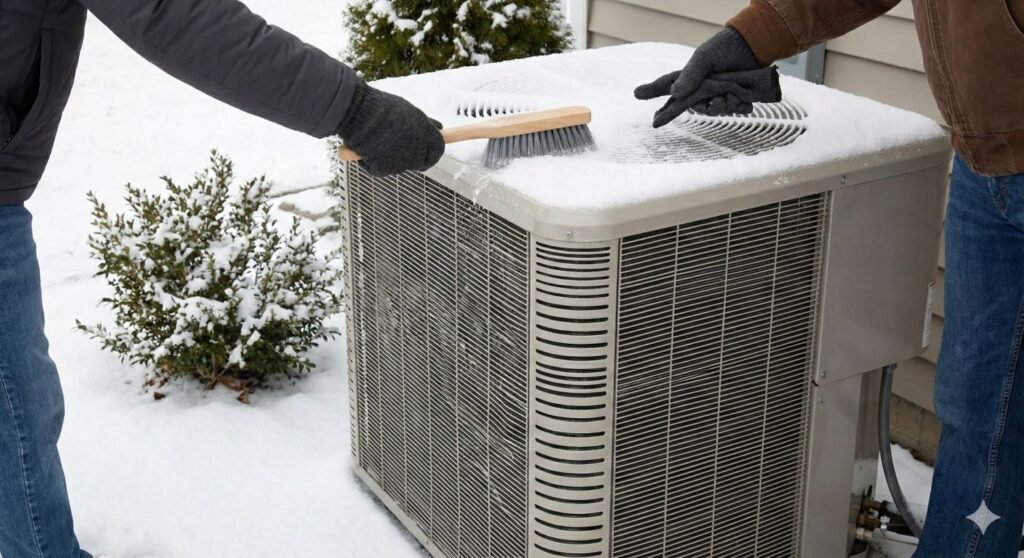
4. Keep the Outdoor Unit Clear
For the system to work, it needs to pull air through the outdoor unit.
- Snow & Ice: After a snowstorm, gently brush snow off the top and sides of the unit.
- Airflow: Ensure leaves, shrubs, or drift snow aren’t blocking the sides.
- Gutters: Check that leaking gutters aren’t dripping water onto the unit, which can freeze and block the fan.
5. Adjust Your Expectations for Air Temperature
Heat pump air often feels cooler (90°F–100°F) coming out of the vents compared to a gas furnace (120°F+).
- It is still warm enough to heat your home, but it may feel “drafty” if you stand directly under a vent.
- If you have a mini-split (wall unit), aim the louvers downward, as heat naturally rises.